

Designing a home involves a unique blend of aesthetics and engineering. While we often spend hours choosing the perfect flooring or paint colors, one of the most critical structural elements in a multi-story home is frequently overlooked: the staircase.
A poorly designed staircase is more than just an inconvenience—it can be a serious safety hazard. To help you build a staircase that ensures a smooth, safe, and comfortable climb, Morrow Homes highlights the gold standard dimensions and safety rules you must follow during construction.
1. Understanding the Core Components: Tread and Riser
Every step you take on a staircase relies on two foundational elements:
-
The Tread: This is the flat, horizontal surface where you place your foot.
-
The Riser: This is the vertical portion that determines the height of each individual step.
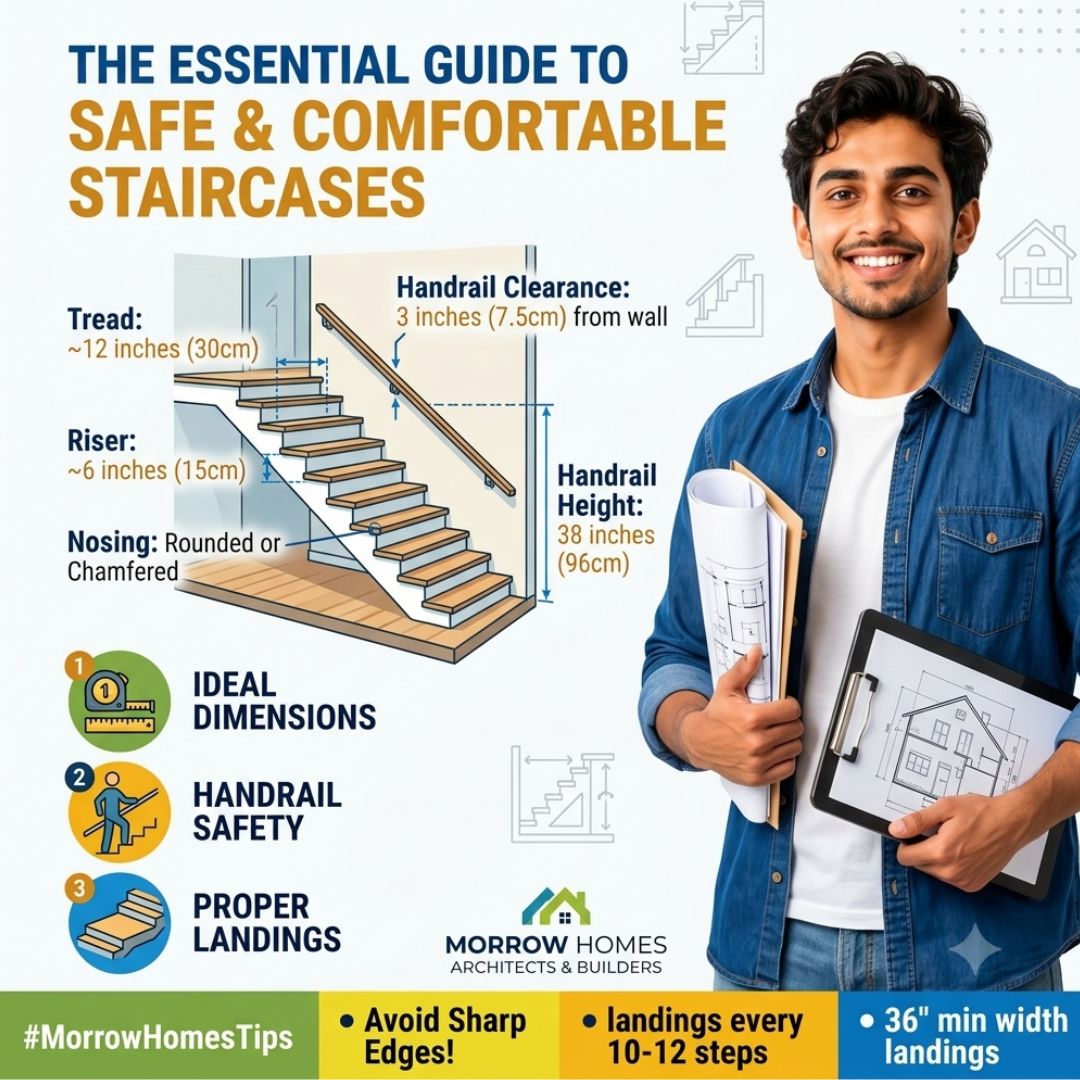
Getting the ratio between the tread and the riser wrong is a leading cause of missteps and accidental trips. For an effortless ascent and descent, the ideal measurement for a tread is approximately 12 inches, providing ample space for an adult foot. Complementing this, the ideal riser height should be roughly 6 inches . Keeping to these standard measurements minimizes leg strain and creates a natural walking rhythm.
2. Edges and Nosing: Safety is in the Details
The small overhang at the edge of each step is known as the nosing . While it helps maximize foot room, the treatment of these edges plays a massive role in injury prevention.
Staircases with sharp edges or completely open-riser styles dramatically increase the risk of painful cuts, slips, and severe falls . To mitigate this risk, it is highly recommended to design stairs with rounded (bullnose) or chamfered (beveled) edges . Smoother, curved corners soften the impact in case of an accidental trip and are far safer for homes with young children or elderly family members.
3. The Importance of Landings
Climbing a continuous, steep flight of stairs can be exhausting. To provide a necessary breathing room and break the momentum of a potential fall, you must incorporate a landing.
Architectural standards dictate that a landing should be provided after every 10 to 12 steps . This gives the climber a flat zone to pause and rest. Furthermore, to ensure that the transition feels natural and spacious, the width of the landing should be at least 36 inches .
4. Perfecting the Handrails and Clearances
A sturdy handrail is your ultimate line of defense on a staircase. However, a railing is only helpful if it sits at an ergonomic height and offers an unobstructed grip.
-
Handrail Height: For optimal stability, the top of your handrails should stand at a height of 38 inches from the step line.
-
Wall Clearance: If your handrail is mounted against a wall, ensure there is a minimum clearance of 3 inches between the handrail and the wall surface. This gap gives your fingers enough room to securely wrap around the rail without scraping against the concrete or plaster.
Conclusion
A beautiful home is nothing without safety and functionality. By sticking to these exact structural measurements—a 12-inch tread, a 6-inch riser, chamfered edges, and perfectly spaced handrails—you can ensure your staircase is a seamless, risk-free asset to your living space.
For more professional architectural insights, home construction guidelines, and smart layout tips, be sure to keep following Morrow Homes!
Watch Now: https://www.youtube.com/shorts/7g8BU8AnCcQ